We analysed 57,000 ads for less than the price of a coffee.

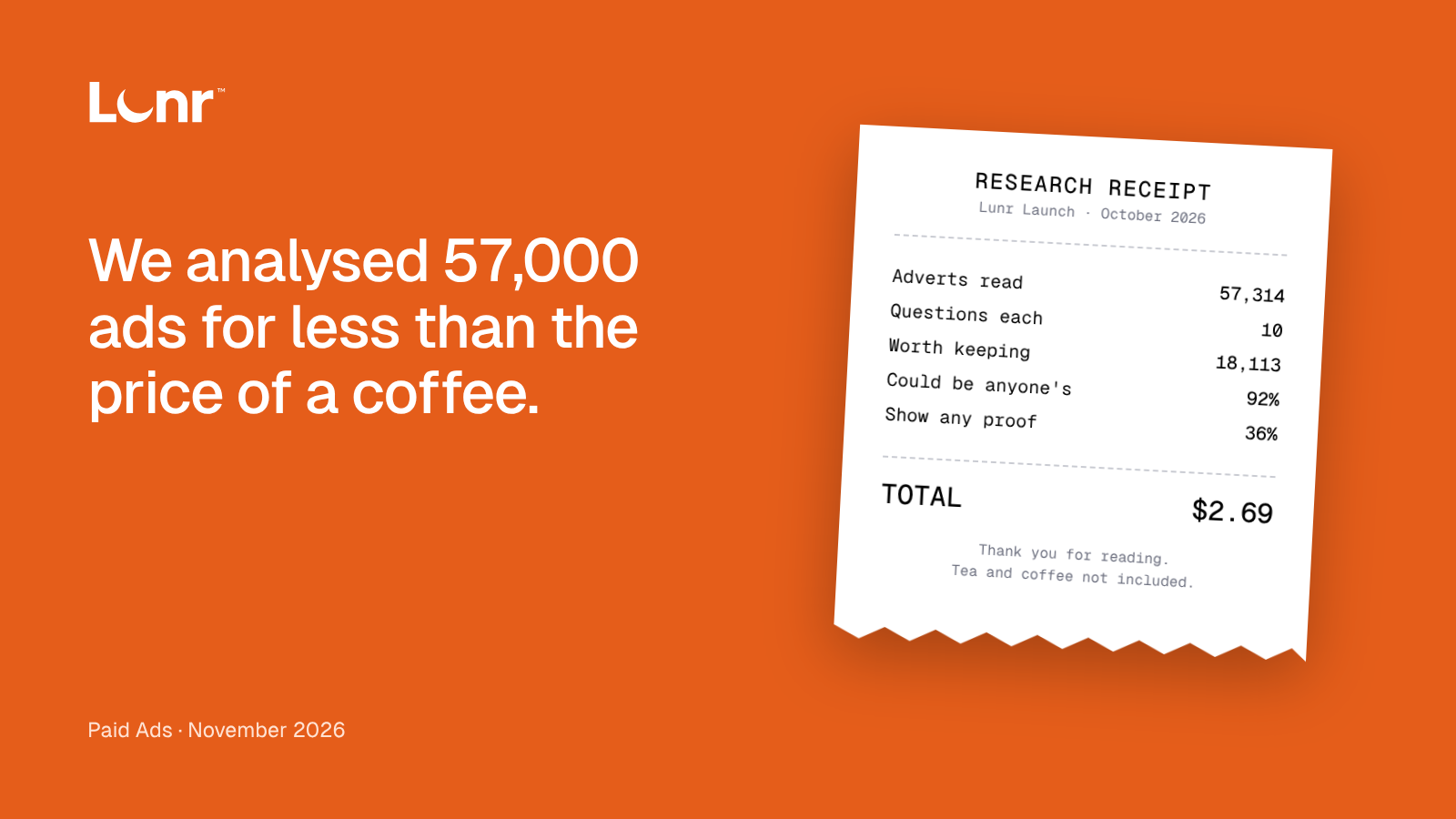
A year ago, if you wanted to read 57,000 adverts properly, you needed a research team, a few months, or software priced for big brands. Last month we did it on one computer for $2.69. That's about £2. Less than a flat white.
Here's what we did, what we found, and why it matters even if you never touch any of this yourself.
Short version: most adverts could belong to anyone, very few show proof, and research like this isn't only for big companies any more.
The tool: Jev
Jev is a new AI model from a company called TypeSafe AI. It launched in September 2026.
It isn't a chatbot, and it doesn't write anything. You give it something to read and a list of questions, and it gives back an answer to each one with a confidence score. Is there an offer in this advert? Yes, 98% sure. Who is it written for? Someone who knows they have the problem but hasn't found a fix yet. TypeSafe's own line for it is "The model doesn't write. It decides."
That's the part I like. I'm wary of AI that writes your marketing for you. This is the opposite: AI that reads, at a scale no person could, so that people can make better decisions.
It's also very cheap and very fast. Jev charges $0.042 for every million tokens it reads (a token is a small piece of text, usually part of a word), and its answers are free. One batch of 323 adverts took it under ten seconds.
What we did
Meta keeps a public record of every advert running on Facebook and Instagram, called the Ad Library. Anyone can search it.
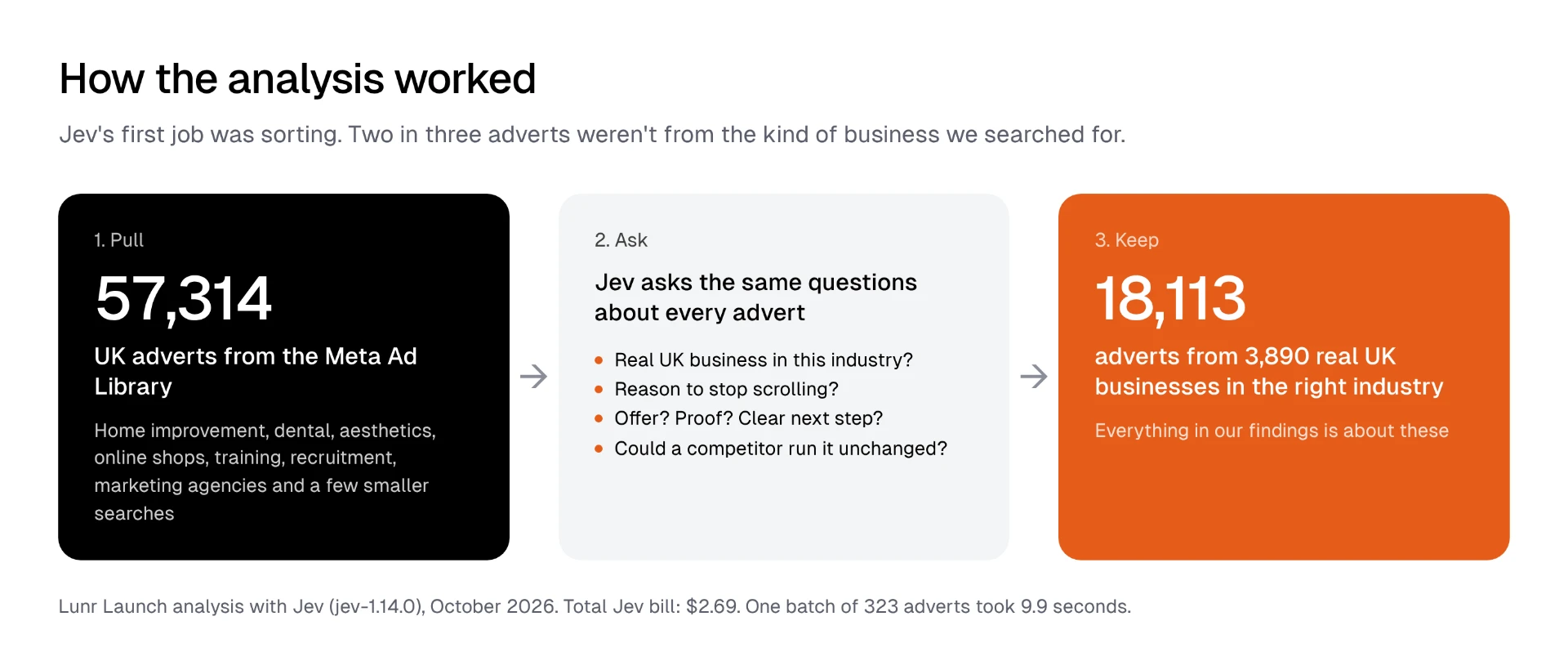
We pulled UK adverts from home improvement, dental and private health, aesthetics clinics, online shops, training and education, recruitment, and marketing agencies like us, plus a few smaller searches. 57,314 adverts in total.
Then we asked Jev the same questions about every one of them:
- Is this from a real UK business in the industry we searched for?
- Does the first line give you a reason to stop scrolling?
- What does the first line do: ask a question, name a problem, make a claim, lead with a price?
- Is there an offer, and what kind?
- Who is it written for: someone who doesn't know they have a problem yet, or someone ready to buy?
- Does it tell you exactly what to do next?
- Does it include specific proof, like real numbers, named results or reviews?
- Could a competitor run this exact text by changing only the name?
That last question turned out to be the most interesting one.
What we found
Two in three adverts weren't what we searched for
Search the Ad Library for a phrase and you get every advert that uses it. That includes the businesses you're after, but also businesses in other industries, businesses outside the UK, drop-shipping stores and spam.
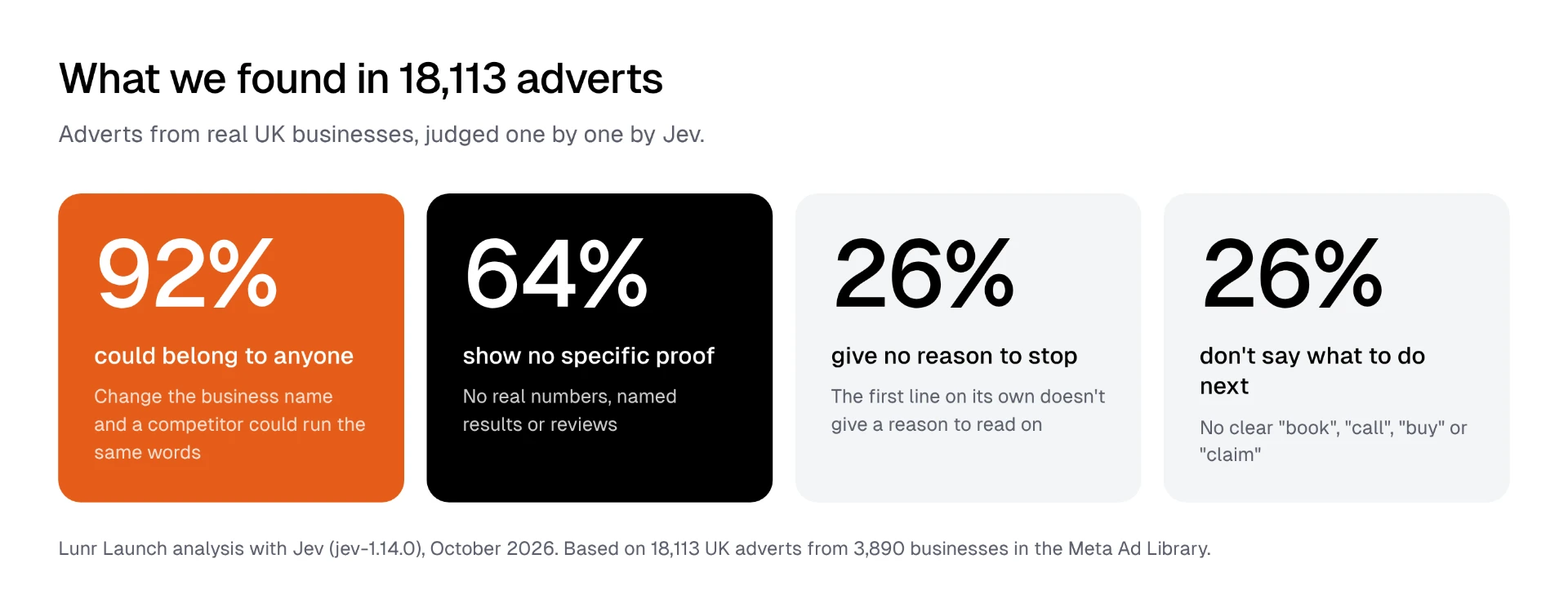
So Jev's first job was sorting. It judged that 18,113 of the adverts came from 3,890 real UK businesses in the industry we were looking at. Everything below is about those. By hand, that sorting alone would have been more than a week of full-time work.
More than nine in ten adverts could belong to anyone
Jev judged 92% of them generic. Change the business name and a competitor could run the same words tomorrow.
"Book your free quote today. Quality kitchens at great prices. Family run, fully insured." I've made that one up, but you've seen it a hundred times.
Only about one in three shows any proof
36% included something specific: a real number, a named result, a review. The rest asked you to take their word for it.
Marketing agencies are some of the worst at it
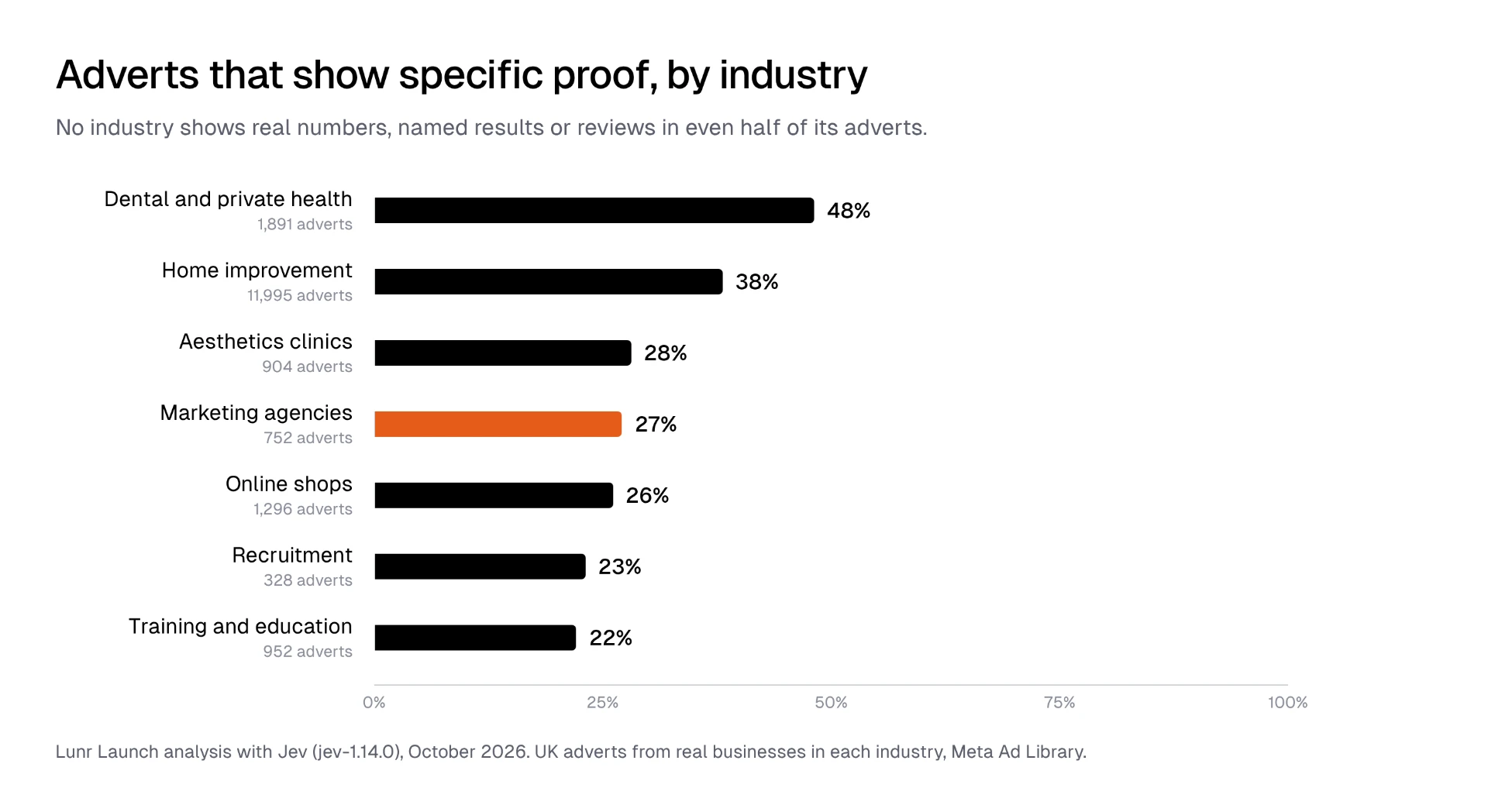
This one stung. We looked at 752 adverts from 105 UK marketing agencies. Agencies sell results for a living, but only 27% of their adverts showed any proof, and Jev judged 95% of them generic.
Even the best industry we looked at, dental and private health, showed proof in fewer than half of its adverts.
Every industry has its own habits
Home improvement leans on the free quote: 55% of its adverts offered one, and three in ten opened with a question, the "Thinking about a new kitchen?" kind. Online shops lead with a discount or free delivery. Nearly half of agency adverts make no offer at all.
That's useful in a different way. If every competitor in your industry offers a free quote, a free quote doesn't make you stand out. It's the minimum.
Same idea, different job: our website
Jev isn't only for adverts. We used it on our own website too.
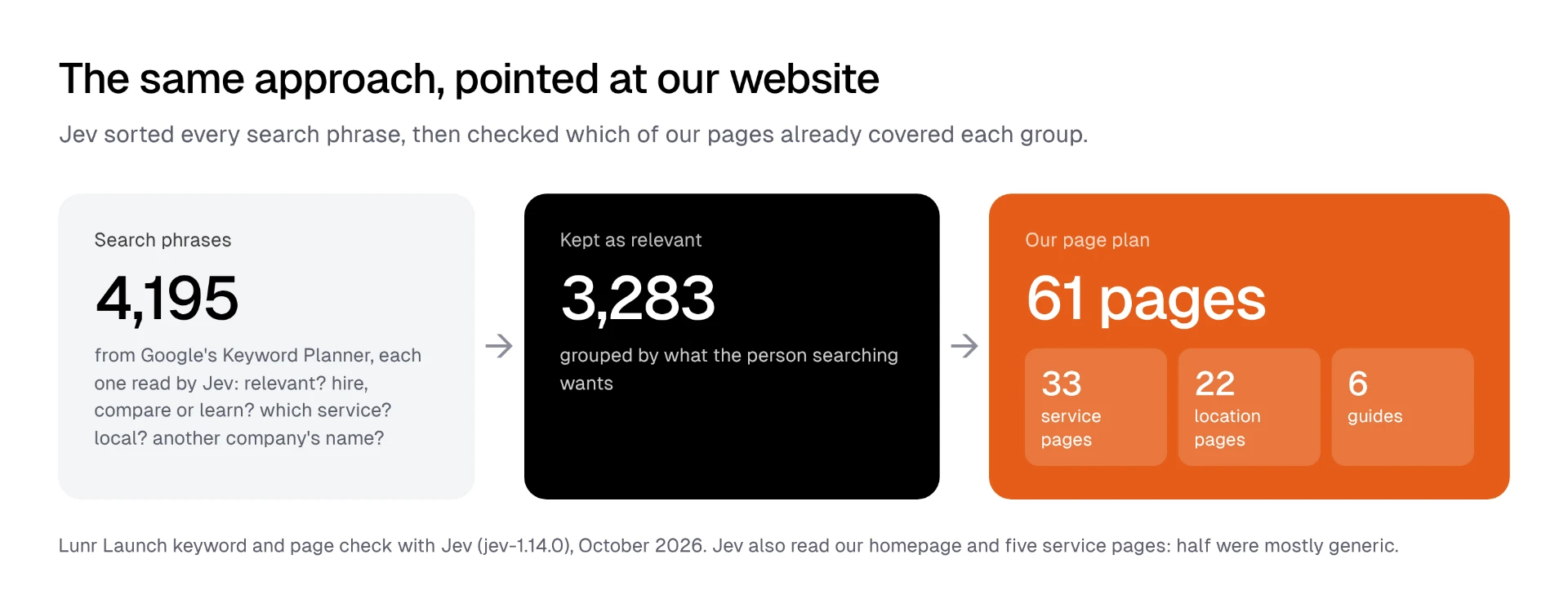
Google's Keyword Planner gave us 4,195 search phrases connected to what we do. Jev read every one and answered five questions. Is this relevant to us? Is the person looking to hire someone, compare options or learn something? Which of our services does it match? Is it local? Does it name another company?
It kept 3,283 phrases, which we grouped into a plan of 61 pages: 33 service pages, 22 location pages and 6 guides. Then Jev read the 29 pages already on our site, worked out which ones covered each group, and checked how well they did it.
It was uncomfortable reading. Of our homepage and five service pages, half were mostly generic and only two showed specific proof. The same problems we'd just found in everyone else's adverts. We've rebuilt our Paid Ads page, and the rest are next.
What it can't tell you
I want to be straight about the limits.
It only read the words. Not the pictures or the video, which is where most of an advert's pull comes from.
The Ad Library doesn't show how much anyone spent, how many people clicked or whether anyone bought. So we can't tell you which of these adverts worked. We checked whether adverts that ran for longer looked any different, and there was no consistent pattern.
And Jev's answers are judgements, not facts. Think of it as a sharp junior who reads very fast, never gets bored and is sometimes wrong. It tells you how sure it is, which helps, but it isn't the final word.
What this means for you
You don't need any of this to improve your own adverts. Three checks:
- The swap test. Put a competitor's name on your advert. If it still reads fine, rewrite it until it doesn't.
- Add one piece of proof. A number, a named result, a real review. Most of your competitors won't have one.
- Make the first line earn the second. If the opening could be anyone's, most people never see the rest.
The bigger point is the cost. Research like this used to belong to companies with research budgets. We're a small team, and it cost us less than a coffee. That changes what a small business, or a small agency, can know about its market.
If you'd like us to look at yours, book a call. If not, try the swap test on your newest advert today.